
What’s the use of Cyanotypes? Let me count the ways: botanical illustrations, architectural and engineering blueprints, medical specimen illustrations and textile patterns, to name just a few. And through both accident and intention, Cyanotypes have given rise to fine art photographs on-and-off since their invention by British scientist Sir John Herschel in 1842. In the first-ever survey of this enduring and recently re-popularized photographic process, the Worcester Art Museum is exhibiting “Cyantotypes: Photography’s Blue Period” through April 24, 2016, with the celebratory reception “An Evening in Blue” this Thursday, February 18th from 6:00 – 8:00pm.
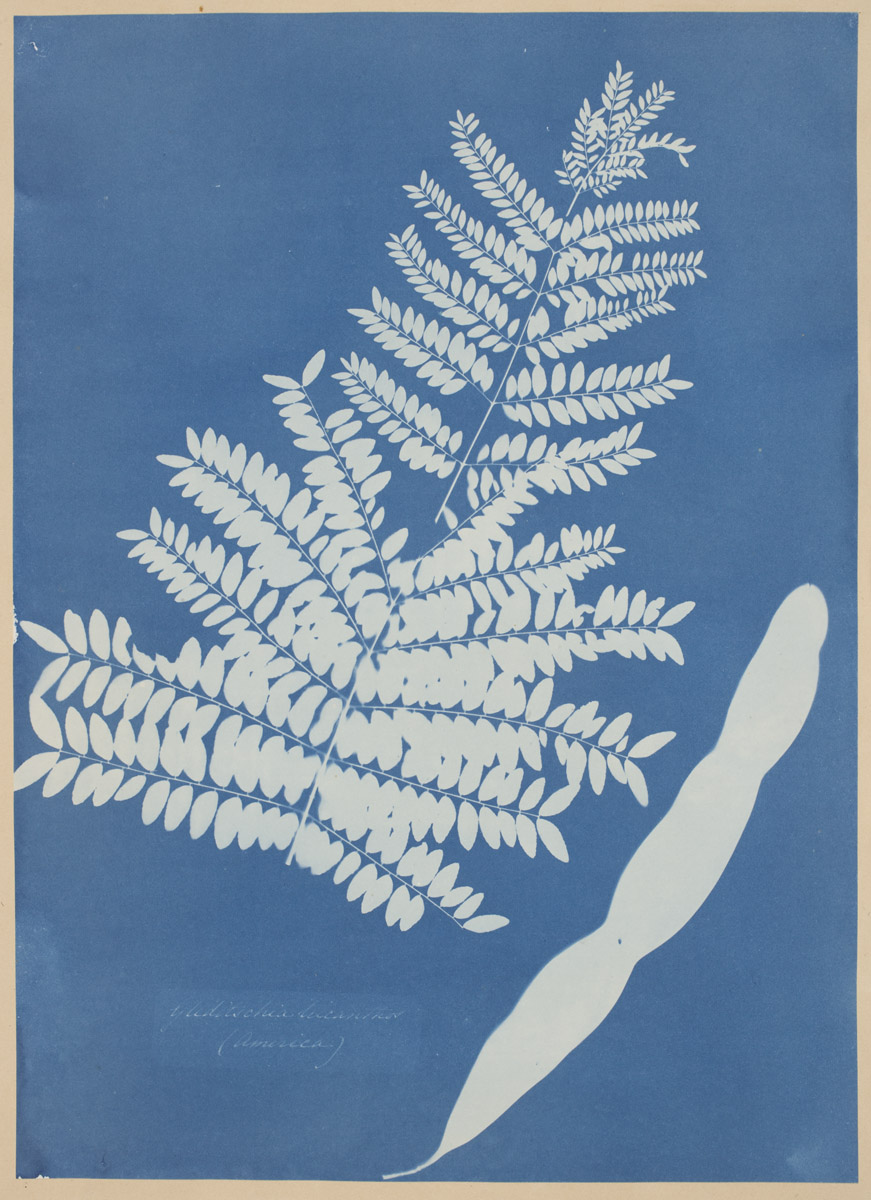
“Honey Locust Leaf Pod, c.1854” by Anna Atkins (British 1799-1871). Courtesy of the Worcester Art Museum, Worcester, MA.
By virtue of its ease of creation, the Cyanotype has been both widely employed for technical purposes and largely dismissed as an artistic medium of distinction throughout its nearly 175-year history. The irrefutable, unadulterated blue-ness of Cyanotypes has had a significant effect on their acceptance as an art form. While some considered the deep cyan hue utilitarian or even offensive, many artists have exploited the Cyanotype’s ability to suggest alienation, fantasy, serenity or romance. After a long fallow period following WWI, the popularity of “alternative processes” to create of fine art photographs over the last 15-20 years has brought interest in the Cyanotype roaring back.

“Blue Moon Diptych (constructed), 2006” by by Jesseca Ferguson (courtesy of the artist and Worcester Art Museum, Worcester, MA).
The scope of this exhibit is not only admirable but delightfully digestible in its size and range. The simple, darkroom-free process for making Cyanotypes is presented, along with informative bits and striking examples. Viewers are treated to a rare photogram by one of the Cyanotype’s earliest adopters, botanist Anna Atkins, who used the sunlight-friendly method to create books cataloging British and American ferns in the 1850’s. These are joined by a generous variety of Cyanotypes from their height of popularity at the turn-of-the-century, including: landscapes and still-lifes by Arthur Wesley Dow and Fred Holland Day, Native American portraits by Edward Sheriff Curtis and a broad collection of cyanotypes by Frederick Coulson, including some saucy portraits of his sister (feature image).

“Photogenic Painting Untitled 75/31, 1975” by Barbara Kasten (courtesy of the artist and Bortolami Gallery, NY).
The show’s historical perspective crescendos with a captivating selection of contemporary pieces. Cyanotypes enjoyed a couple of brief resurgences after WWI, particularly in the 1970’s, when artists like Barbara Kasten were drawn to its potential for creating abstracts. Her photogram utilizing fiberglass mesh is as elegant as it is ethereal.

“Unwound Casette Tape, 2012” by Christian Marclay (courtesy of the artist and Paula Cooper Gallery, NY).
The newest work is particularly exciting in the way it broadens the expressive power of cyanotypes. Christian Marclay utilizes the archaic cyanotype method to “record” another outdated medium in his photogram of an unwound cassette tape. Jesseca Ferguson’s tantalizing assemblages of 19th Century bookbindings with cyanotypes printed on found papers conjure imaginary stories and remembered dreams from the Victorian era in which cyanotypes were born.

Left: “Moonscape – moon (constructed), 2014” and Right: “Moonscape – mountains (constructed), 2014” by Jesseca Ferguson (courtesy of the artist and Worcester Art Museum, Worcester, MA).
John Dugdale capitalizes on the cyanotype’s rich blue tonality to evoke a supreme sense of peace in his classical portrait “Stillness of Spirit”. Annie Lopez’s mixed media narrative on personal, gender and cultural identity is a spectacular dress, fabricated from tamale paper (a reference to her Mexican American heritage), printed with Cyanotypes of medical illustrations and text along with family adages.

“Stillness of Spirit, 1996” by John Dugdale (courtesy of the artist and Worcester Art Museum, Worcester, MA).
There are many other gems in this treasure trove. The Worcester Art Museum has mounted fascinating history of technology, science and art, all rolled into one engaging exhibit. For more information about this show and the museum’s “Evening in Blue” celebration this Thursday, February 18, 2016, go to: http://www.worcesterart.org/exhibitions/cyanotypes-photographys-blue-period/
Feature Image: “Artist’s Sister Smoking a Cigarette, 1895” cyanotype by Frederick Coulson (American, 1869-1931) Courtesy of the Worcester Art Museum, Worcester, MA.

Installation view of “Medical Conditions, 2013” by Annie Lopez (courtesy of the artist and Worcester Art Museum, Worcester, MA).
 Share On Facebook
 Tweet It


